
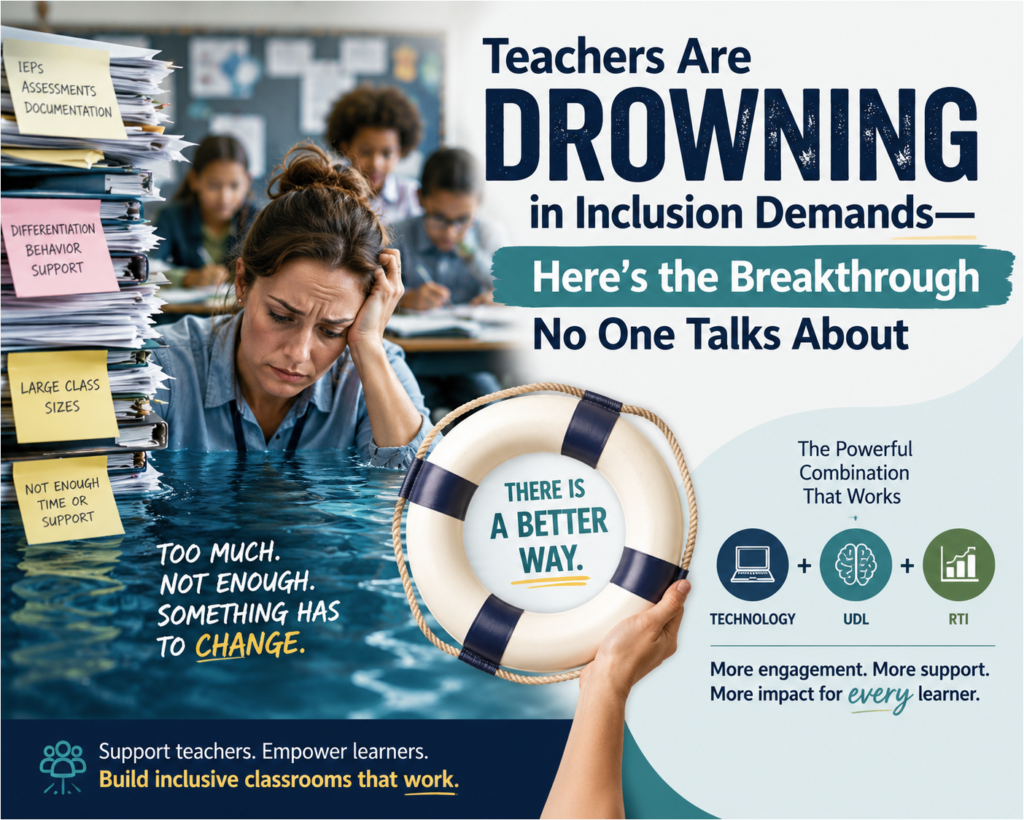
Teachers Are Drowning in Inclusion Demands; Here’s the Breakthrough No One Talks About
Inclusive education was never meant to be a checkbox; it was meant to be a transformation.In Ontario, some classrooms are attempting to transition from integration to true inclusion. But while the vision is powerful, the reality for many educators is complex: increasing student needs, limited time, and insufficient resources.
So what’s actually working?
Teachers who successfully navigated this shift didn’t just add tech, they reimagined instruction.
They:
✔ Used technology to offer multiple ways for students to engage, learn, and demonstrate understanding
✔ Leveraged tools like text-to-speech, collaborative platforms, and multimedia assessments
✔ Built classroom systems that supported both independence and differentiation
The result?
Increased student engagement, stronger teacher capacity, and more equitable access to learning.But here’s the tension we can’t ignore:
Even in these successful classrooms, teachers still faced barriers; especially around early screening, data management, and access to streamlined assessment tools. Many were forced to create their own systems, adding to an already heavy workload.
The takeaway is clear:
Technology alone isn’t the solution.
Frameworks alone aren’t the solution.
But together, when aligned thoughtfully, they create powerful conditions for inclusion.
If we truly believe every student deserves to be known and supported, then we must also design systems that support teachers just as intentionally.
Because inclusive education doesn’t succeed on effort alone, it succeeds on structure.
Source:
Montgomery, D. (2022). Integrating Technology With Instructional Frameworks to Support all Learners in Inclusive Classrooms. The Open Technology in Education, Society, and Scholarship Association Journal, 2(2), 1–16. https://doi.org/10.18357/otessaj.2022.2.2.31
*