
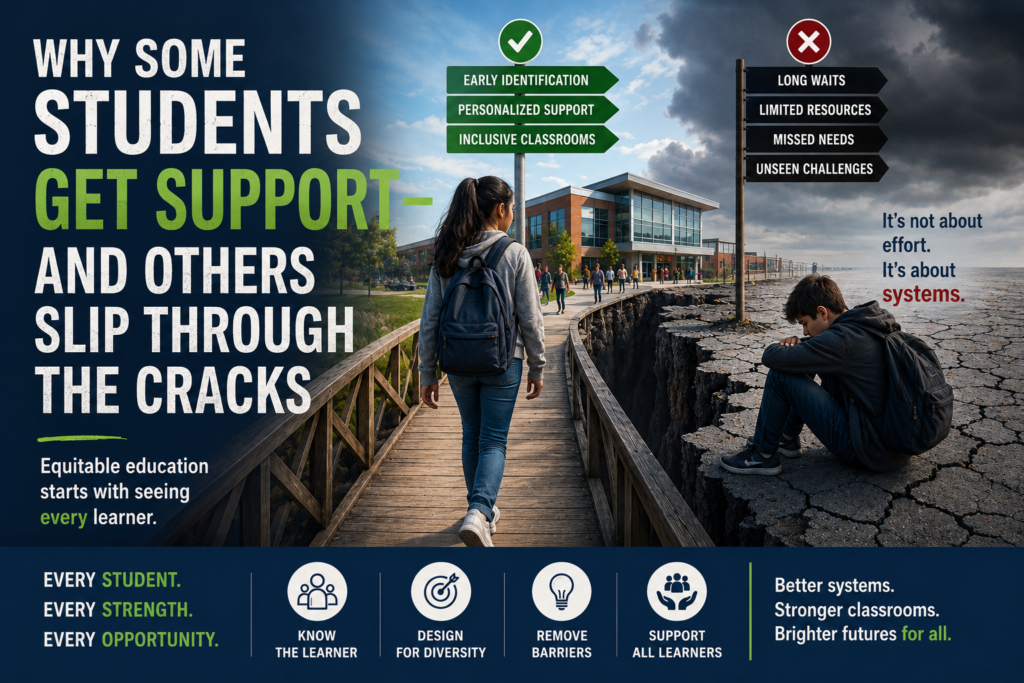
Why Some Students Get Support and Others Slip Through the Cracks
The number of students requiring additional learning support in Canada is rising; yet our systems for identifying and supporting those needs remain inconsistent, inequitable, and in many cases, outdated.In Ontario alone, an estimated 17% of elementary and 27% of secondary students require special education support. And even these numbers don’t tell the full story. Many students with “invisible” learning challenges; like anxiety, ADHD, or processing differences, are still going unrecognized.
The real issue isn’t just prevalence. It’s access.
Across Canada, support for students is often determined by where they live, how quickly they can access assessments, or whether they receive a formal diagnosis. Some students get immediate help when a teacher notices a need. Others wait months, or years, for psycho-educational assessments. And too many fall through the cracks entirely.
This creates a system where support is reactive, not proactive.
For decades, education has leaned heavily on a medical model; requiring a diagnosis before action. While this approach has value, it often delays support and places the burden on the student to “fit” the system.
But what if we flipped that thinking?
A growing shift toward inclusive education challenges us to move beyond labels and instead focus on how students learn. Frameworks like Universal Design for Learning (UDL) and student-centered approaches emphasize flexibility, choice, and accessibility for all learners; not just those with formal designations.
Because here’s the truth: every student is a diverse learner.Through my work as an Educational Therapist, I’ve seen firsthand that meaningful inclusion starts with understanding the whole learner; their strengths, motivations, and preferences, not just their challenges.
And when students are actively involved in that process, everything changes.
When students understand how they learn, they become more engaged.
When teachers have clearer insight into student needs, they can teach more effectively.
When communication between educators, families, and students improves, outcomes follow.
Yet teachers are being asked to do this complex work in classrooms of 25+ students, often without the time, tools, or training to do it well.
That’s the gap we need to solve.
The future of inclusive education isn’t just more resources—it’s smarter systems.
We need practical, scalable tools that help teachers identify learning needs early, design responsive instruction, and build student ownership in the learning process. Approaches like student-directed, holistic assessments; embedded at the “assessment for learning” stage, have the potential to transform both identification and engagement.
Inclusion was never meant to be about adding more to a teacher’s plate.
It was meant to redesign the plate entirely.
If we truly want equitable education, we must shift from waiting for proof of need… to proactively designing for variability from the start.
Because inclusion done right doesn’t just support some students; it unlocks success for all.
Study Smart’s Student-Directed Holistic Assessment program may be one solution.
*
References:
Montgomery, D. (2026). A Student-Directed Holistic Assessment Approach to Help Teachers Support the Diverse Needs of Students
and Develop Self-Regulated Learners in Inclusive Educational Settings. Dissertation. UPEI.
People for Education. (2019). 2019 Annual report on schools: What makes a school? 2019 Annual report on schools: What makes a school? – People for Education
Statistics Canada. (2022). Canadian Survey on Disability, 2017 to 2022. Retrieved from:
(Statistics Canada, 2022) https://www150.statcan.gc.ca/n1/dailyquotidien/231201/dq231201b-eng.htm https://www.vha.ca/blog/understanding-nonvisible-disabilities/