
*
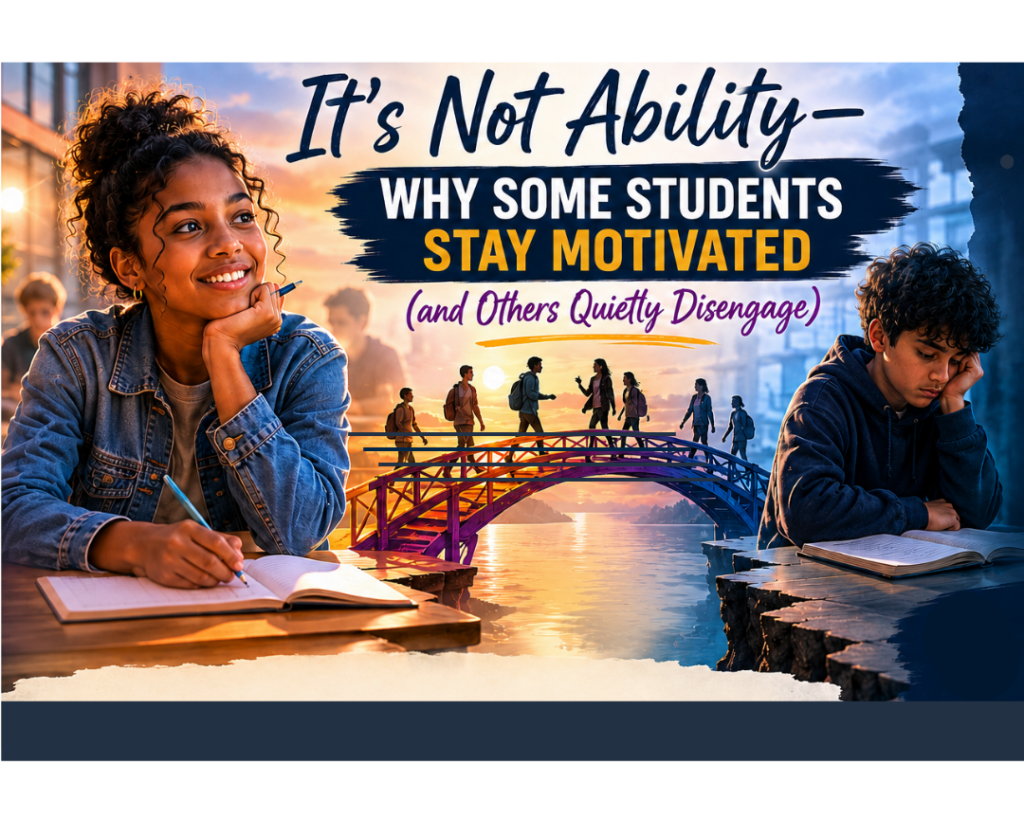
It’s Not Ability. Why Some Students Stay Motivated (and Others Quietly Disengage)
Why do some students thrive while others quietly disengage, despite being in the same classroom?
It’s a question educators have wrestled with for decades. And while it’s easy to point to effort, ability, or even behavior, the real answer runs much deeper.
It comes down to motivation, not as a trait students either have or don’t have, but as something shaped by the environments we create.
For years, influential thinkers like Bandura and Dweck helped us better understand this. Bandura’s work on self-efficacy revealed that students are more likely to engage when they believe they can succeed. Dweck’s research on growth mindset showed that students who see ability as developable are more willing to embrace challenge and persist through difficulty.
These ideas transformed education. But they also left an important question unanswered:
What actually creates the conditions for those beliefs to form in the first place?
That’s where Self-Determination Theory (SDT) offers a powerful lens, and perhaps one of the most important breakthroughs in understanding student-centered learning.
According to SDT, motivation is not random. It is driven by the extent to which three basic psychological needs are met:
✔️ Competence – the belief that “I can do this”
✔️ Autonomy – the feeling that “I have some control or choice”
✔️ Relatedness – the sense that “I belong here and I matter”
When these needs are supported, students don’t just participate; they invest. They take ownership. They become active agents in their learning.
But when these needs are not met, something different happens.
Students may comply. They may complete tasks. They may even achieve.
But beneath the surface, disengagement grows.
This is where many classrooms unintentionally fall short.
Despite our best intentions, traditional systems often emphasize control over curiosity; prioritizing standardized outcomes, rigid structures, and performance-driven goals. In these environments, motivation becomes external. Students work for grades, approval, or avoidance of failure.
And while that can produce short-term results, it rarely builds long-term learners.
In contrast, autonomy-supportive, student-centered environments shift the focus.
They don’t remove structure, but they redefine it.
Instead of asking, “How do we get students to do the work?” the question becomes:
“How do we design learning so students want to engage in the work?”
This shift is subtle, but transformational.
In these classrooms:
✨ Students are given meaningful choices that connect to their interests
✨ Teachers scaffold learning to ensure early and repeated experiences of success
✨ Feedback focuses on effort, growth, and strategy—not just outcomes
✨ Mistakes are reframed as essential parts of learning, not indicators of failure
✨ Relationships are prioritized, creating psychological safety and trust
And the impact is profound.
Research consistently shows that students in autonomy-supportive environments demonstrate higher intrinsic motivation, stronger persistence, greater creativity, and deeper conceptual understanding.
But perhaps even more importantly, they begin to see themselves differently.
They don’t just think, “I passed.”
They start to believe, “I am capable.”
That identity shift is what sustains learning beyond the classroom.
However, implementing this approach is not without its challenges.
Educators often navigate competing pressures; curriculum demands, standardized testing, time constraints, and diverse learner needs. And for some students, particularly those who have experienced repeated failure, autonomy alone is not enough.
They may still require structure, guidance, and reassurance to rebuild a sense of competence.
This is where balance becomes critical.
The most effective student-centered environments are not unstructured; they are intentionally designed to integrate:
👉 Clear guidance and scaffolding to support competence
👉 Strong, authentic relationships to foster relatedness
👉 Meaningful choice and voice to cultivate autonomy
When these elements work in harmony, motivation shifts along a continuum; from externally controlled (“I have to”) to internally driven (“I want to”).
And that shift changes everything.
Because at its core, student-centered learning is not just about pedagogy.
It’s about humanity.
It’s about recognizing that students are not passive recipients of knowledge, but individuals with unique experiences, needs, and aspirations.
When we start with that understanding, when we design learning environments that honor competence, autonomy, and belonging; we don’t just increase engagement.
We create conditions where all students, including those who have historically been marginalized or disengaged, have a genuine opportunity to thrive.
And that’s the real breakthrough.
Not a new program.
Not a new strategy.
But a fundamental shift in how we understand motivation, and how we respond to it.
Because when students feel capable, connected, and in control of their learning…
They don’t just succeed in school.
They carry that confidence with them for life.
*
References:
Bandura, A. (1997). Self-efficacy. The exercise of control. W.H. Freeman/Times Books/Henry Holt & Co.
Deci, E. L., & Ryan, R. M. (1985). Intrinsic motivation and self-determination in human behavior. New York, NY: Plenum
Dweck, C.S. (2016) Mindset: The new psychology of success. Random House.
Dweck C.S., & Yeager D.S. (2019) Mindsets: A view from two eras. Perspectives on Psychological Science. 2019 May;14(3):481-496. doi: 10.1177/1745691618804166.
Montgomery, D. (2026). A Student-Directed Holistic Assessment Approach to Help Teachers Support the Diverse Needs of Students
and Develop Self-Regulated Learners in Inclusive Educational Settings. Dissertation. UPEI.
Ryan, R.M. & Deci, E.L. (2020). Intrinsic and extrinsic motivation from a self-determination theory perspective: Definitions, theory, practices, and future directions. Contemporary Educational Psychology. 61(2020).
*